Complete Guide to Commercial Lighting Design
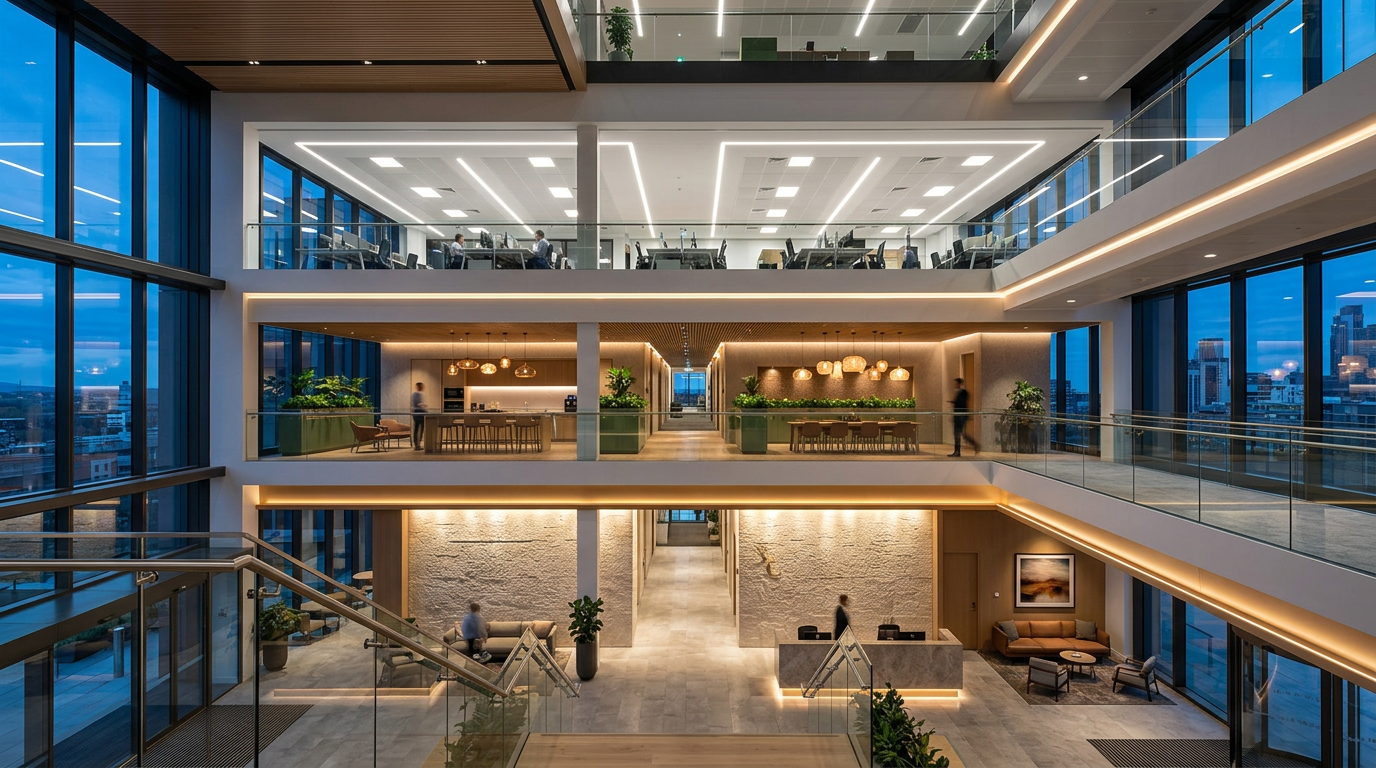
Commercial lighting design is a vital part of design process to create functional, efficient, and visually comfortable environments. Well-lit spaces enhance productivity, safety, and customer experience.
This commercial lighting design guide UK will walk you through everything you need to know before you have a lighting consultation, or embark on a new project, including lighting types, lux level standards, glare control, layouts, and smart lighting systems. Whether you're designing an office space, a retail unit, data centre, or hospitality venue, this guide will help you understand how to design commercial lighting effectively.
What is Commercial Lighting Design?
Commercial lighting design is the strategic planning and implementation of lighting and lighting systems in non-residential environments such as offices, retail stores, industrial facilities, and public buildings.
Good lighting design considers:
-
Functionality
-
Energy efficiency and sustainability
-
Visual comfort (reducing glare and eye strain)
-
Aesthetic appeal
-
Compliance with UK standards (e.g., BS EN 12464-1) and emergency lighting regulations (most notably BS 5266-1:2025)
-
Instrumental to achieving building certifications like BREEAM or WELL
Types of Commercial Lighting
Not all lighting is equal. Understanding the different lighting layers is key to successful lighting design for commercial spaces. The most frequently used approach is called the 3 Layer Approach. It is using:
1. Ambient Lighting
-
The primary source of illumination providing overall visibility.
- Examples: LED panels, downlights, linear lighting
- Used in: Offices, corridors, retail floors
2. Task Lighting
Focused lighting for specific activities, allowing people to carry out specific tasks.
- Examples: Linear lighting, Spotlights, track lighting
- Used in: Offices, workshops
3. Accent Lighting
Enhances or highlights architecture. It can be a part of joinery or decorative fittings adding extra layer of light into the space.
-
Examples: Desk lamps, under-cabinet lighting
-
Used in: Retail displays, office spaces
Lux Level Guidelines (UK Standards)
Office Lighting and commercial lighting need to meet certain guidelines when delivering a project. The unit light is measured in, is Lux. The Lux levels measure how much light is delivered to a surface. This part of the lighting design is also known as light calculations. It is carried out using a software, most commonly DIALux. Following correct levels is essential for compliance and comfort.
Recommended Lux Levels:
When designing lighting for commercial spaces, it is important to understand that spaces need to achieve correct levels to be compliant.
-
Offices (general): 300–500 lux
-
Detailed office work: 500–750 lux
-
Retail spaces: 300–1000 lux
-
Warehouses: 100–300 lux
-
Corridors: 100–200 lux
These are referred to as horizontal illuminance levels. These recommendations align with UK standards such as BS EN 12464-1: 2021, forming a core part of any commercial lighting design guide UK. There are situations, when additional lighting is required. Illuminance might have to be adjusted depending on the factors like:
-
Age of occupants
-
Task contrast
-
Accuracy requirements
-
Duration of task
UGR & Glare Control
Glare is one of the most common issues when it comes to office lighting. It causes eye strain, headaches, and fatigue, reducing employee productivity and comfort. It creates excessive brightness contrasts or reflections on computer screens, causing workers to adopt poor postures as they try to view their screens.
What is UGR?
Glare is measured in UGR (Unified Glare Rating). This rating measures how likely a light source is to cause discomfort glare.
Recommended UGR Levels:
-
Offices: UGR < 19
-
Industrial areas: UGR < 22–25
-
Retail: Depends on design intent
How to Reduce Glare:
-
Use low-glare luminaires
-
Position lights correctly (avoid direct line of sight)
-
Incorporate micro prismatic diffusers or prismatic lenses in offices
-
Use indirect lighting where possible
Effective glare control is essential in office lighting design, where visual comfort directly impacts productivity. Specifiers and designers need to be aware the UGR rating is not a fixed property of a single fitting. The glare rating depends entirely on the installation — the room, surfaces, spacing, angles, even the viewer’s position. It is calculated for the entire installation in DIALux.
Lighting Layouts
Lighting layout design determines how light fittings are arranged in a specific space to ensure uniformity and efficiency. There are different approaches when it comes to creating lighting layouts for CAT A and CAT B fit out scenarios.
Key Principles for CAT A fit out:
-
Even light distribution as the furniture and space layout is unknown
-
Avoid over-lighting or dark spots
-
Consider ceiling height and room dimensions
-
Align lighting with speculative workspace layout into grids
Key Principles for CAT B fit out:
-
Specific light distribution for workstations, breakout zones, quiet areas
-
Consider ceiling height and room dimensions in more detail
-
Lighting designed to suit specific needs of a client
Common Layout Types:
-
Grid layout (offices, retail)
-
Linear layout (corridors, warehouses)
-
Feature-focused layout (hospitality, retail displays)
A well-planned layout is fundamental when learning how to design commercial lighting.
Lighting Controls (DALI & Smart Lighting)
Modern commercial lighting design increasingly utilises intelligent control systems. Controlling light is not a nice to have anymore. With buildings aiming to achieve higher sustainability credentials, it is becoming a standard requirement in modern workplace. There are several types of lighting control systems, DALI system being the most used in commercial environments. When specifying lighting systems, it is important to ensure that selected lighting is compatible with lighting controls.
DALI (Digital Addressable Lighting Interface)
-
Enables Individual fixture control
-
Scene setting capability
-
Energy-efficient operation
-
Ideal for offices and large buildings
Smart Lighting Systems
-
Motion sensors (occupancy detection)
-
Daylight sensors only uses lighting when it is necessary
-
App or cloud-based control
-
Smooth integration with building management systems
Benefits of integrating lighting controls into your project:
-
Reduced energy costs
-
Increased flexibility
-
Improved user experience
Sector Applications
Different industries require tailored lighting design for commercial spaces. There is a huge difference when designing office space, a data centre or retail space for example.
Office Lighting Design
-
Focus on comfort, flexibility and productivity
-
High visual comfort and low glare (UGR < 19)
-
Even illumination
-
Adjustable lighting and more user control is required
Retail Lighting
-
High contrast and accent lighting to create inspiring spaces
-
Highlight products
-
Create an inviting atmosphere and experience
Industrial & Warehouse Lighting
-
High-output, durable fixtures with low maintenance
-
Focus on safety and visibility
-
Energy-efficient high bays
Hospitality Lighting
-
Warm, inviting tones
-
Layered lighting design
-
Strong emphasis on aesthetics
Energy Efficiency & Compliance
In the UK, commercial lighting must meet energy regulations such as:
-
Part L Building Regulations
-
Use of LED technology is a norm
-
Efficient control systems
Energy-efficient lighting reduces operational costs and environmental impact—making it a critical part of any lighting design guide UK.
Commercial Lighting FAQs
What is the most important factor in commercial lighting design?
Balancing functionality, comfort, and energy efficiency is key.
How do I choose the right lux level?
It depends on the task being performed. The latest lighting standard BS EN 12464-1: 2021 contains the table with lux levels for each specific area in commercial environment.
What is UGR in lighting?
UGR measures glare. Lower values mean more comfortable lighting.
Is DALI worth it?
Yes, especially for larger projects where control, flexibility, and energy savings are important.
How can I make my lighting more energy efficient?
Use LED fixtures, install motion sensors, and implement smart lighting controls.
Conclusion
A well-planned commercial lighting design improves productivity, enhances aesthetics, and reduces energy costs. By understanding lighting types, lux levels, glare control, layouts, and smart systems, you can create effective lighting solutions for any commercial environment.
If you're planning a project and need expert advice, investing in a professional commercial lighting design guide UK approach will ensure compliance, efficiency, and long-term success.