Understanding DALI and Casambi: Two Approaches to Modern Lighting Control
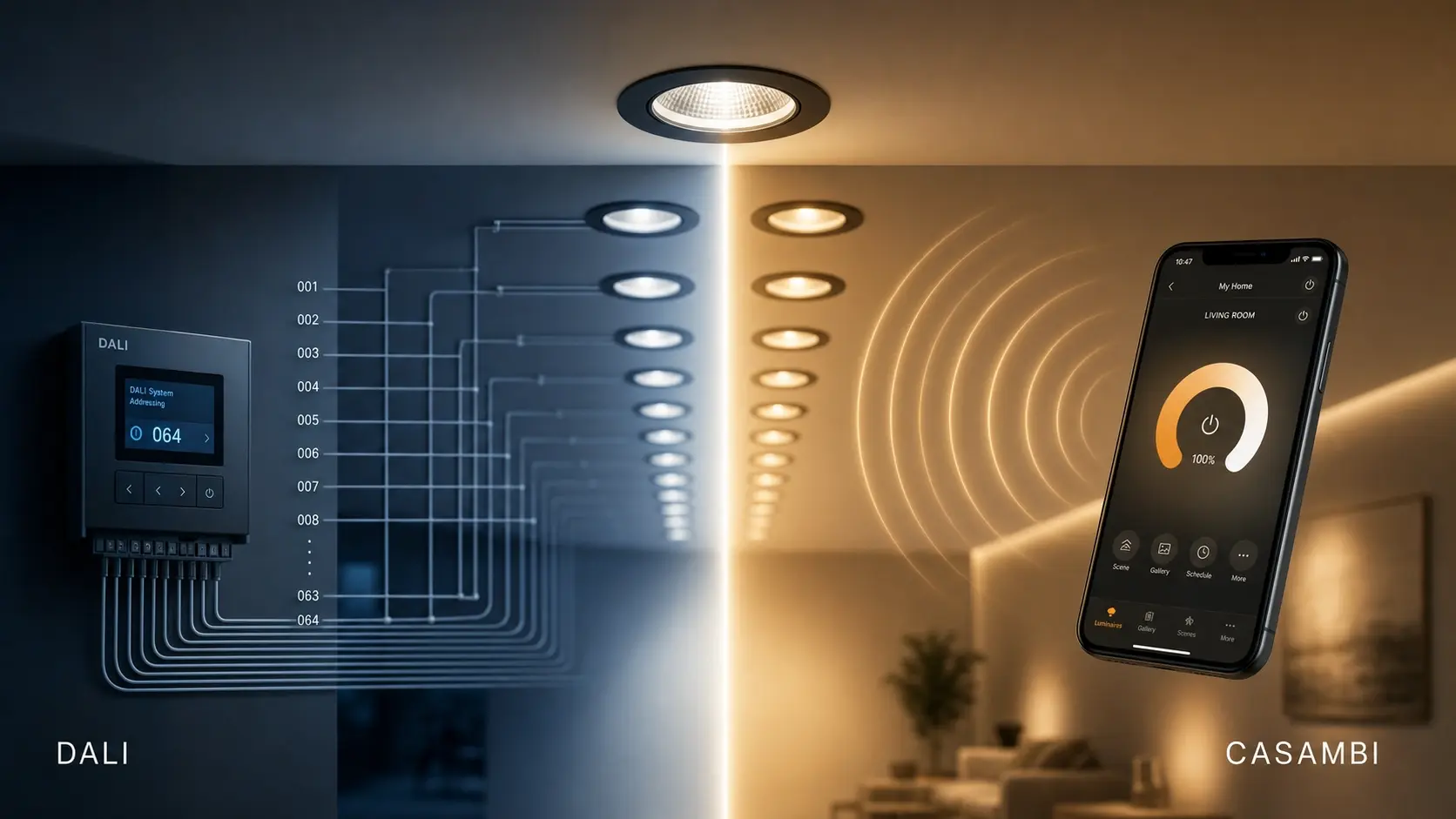
Commercial lighting has moved far beyond the on/off switch. When you're specifying lighting for a modern office, retail space, or education building, control systems determine how flexible, energy-efficient, and user-friendly the scheme will be. Two technologies dominate this space: DALI wired control and Casambi wireless mesh.
Each system addresses different project constraints. Understanding how they work and when each makes sense helps architects, lighting designers, and electrical engineers make better decisions for their schemes. At 299 Lighting, we integrate both technologies across our product range, giving project teams options that match specific site requirements.
Key Takeaways: How DALI and Casambi Work in Commercial Lighting
- DALI uses a two-wire bus to address up to 64 luminaires individually, supporting 16 groups and 16 scenes per segment.
- Casambi creates a Bluetooth Low Energy mesh network that eliminates dedicated control wiring for installation flexibility.
- DALI-2 certification ensures interoperability between drivers, sensors, and controllers from different manufacturers.
- 299 Lighting integrates Casambi into linear, suspended, downlight, and bespoke luminaires.
- Hybrid systems combine DALI wired infrastructure with Casambi wireless extensions for retrofit and refurbishment projects.
What Is DALI and How Does It Control Luminaires?
DALI stands for Digital Addressable Lighting Interface. It's a standardised protocol defined by IEC 62386 that enables two-way communication between a controller and individual luminaires over a dedicated two-wire bus.
The wiring is polarity-free, which removes a common installation error. Each driver receives a unique address between 0 and 63, assigned automatically during commissioning. A single bus segment supports up to 64 devices, with larger buildings adding segments linked through gateways.
Two-way communication is what separates DALI from older analogue systems. The controller sends dimming commands to luminaires, and luminaires report back their status, including lamp failures or driver faults. This feedback loop makes maintenance more efficient because facilities teams receive precise location data when something fails.
How Does DALI-2 Improve on the Original Protocol?
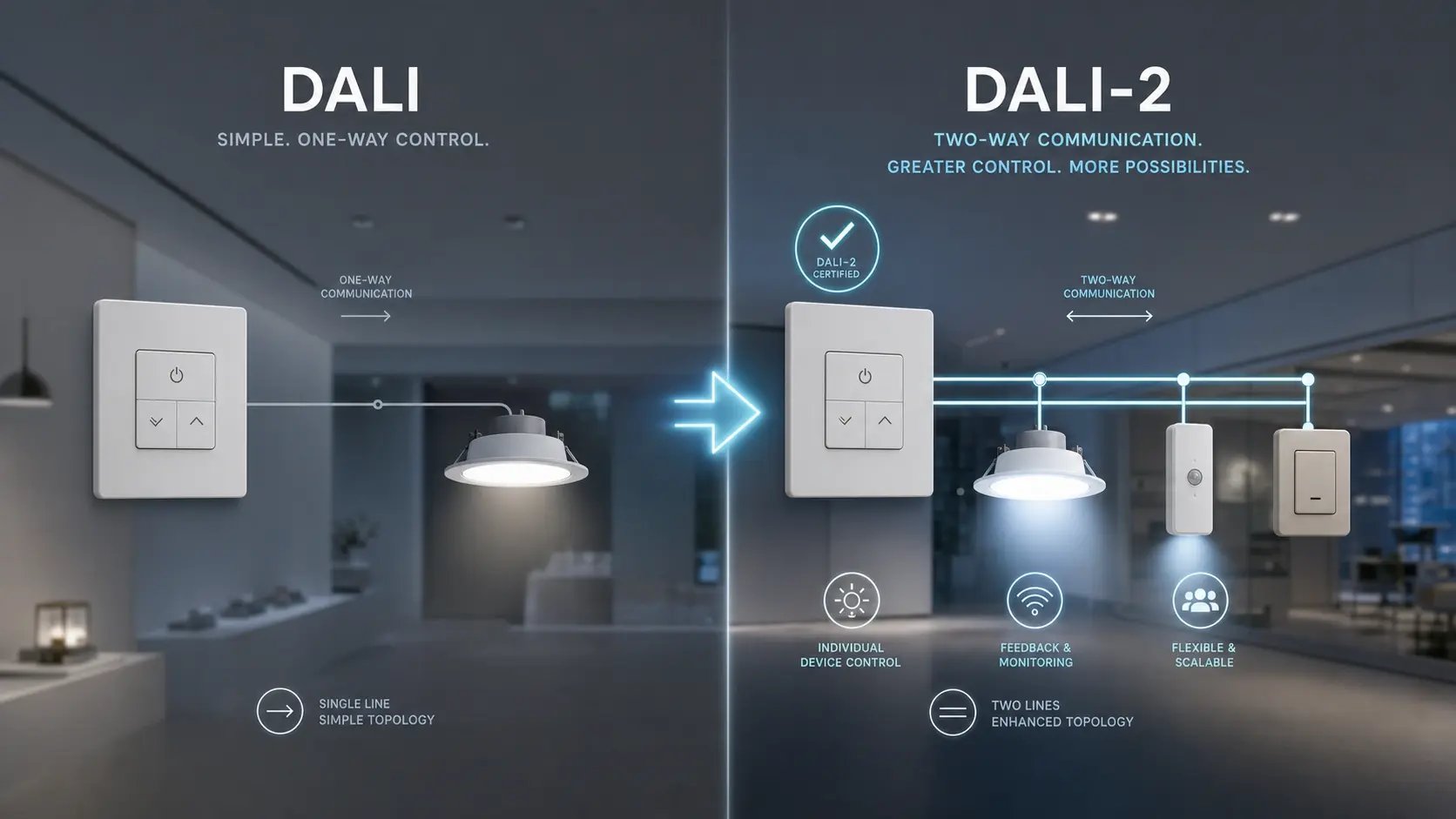
DALI-2 is the current certified version of the standard. Its most significant change isn't extended dimming range; it's standardising the control device ecosystem. Sensors, switches, and controllers from different manufacturers now work together reliably because certification is mandatory.
With the original DALI specification, some manufacturers added their own features, creating compatibility issues. DALI-2 certification, administered by the Digital Illumination Interface Alliance (DiiA), guarantees that certified devices meet IEC 62386 requirements.
The practical upgrade most building managers notice first is certified input devices. A DALI-2 presence detector can automatically dim or switch off luminaires in unoccupied zones without manual intervention. Real-time energy monitoring and standardised diagnostics make ongoing building management more straightforward.
What Is Casambi and How Does the Mesh Network Function?
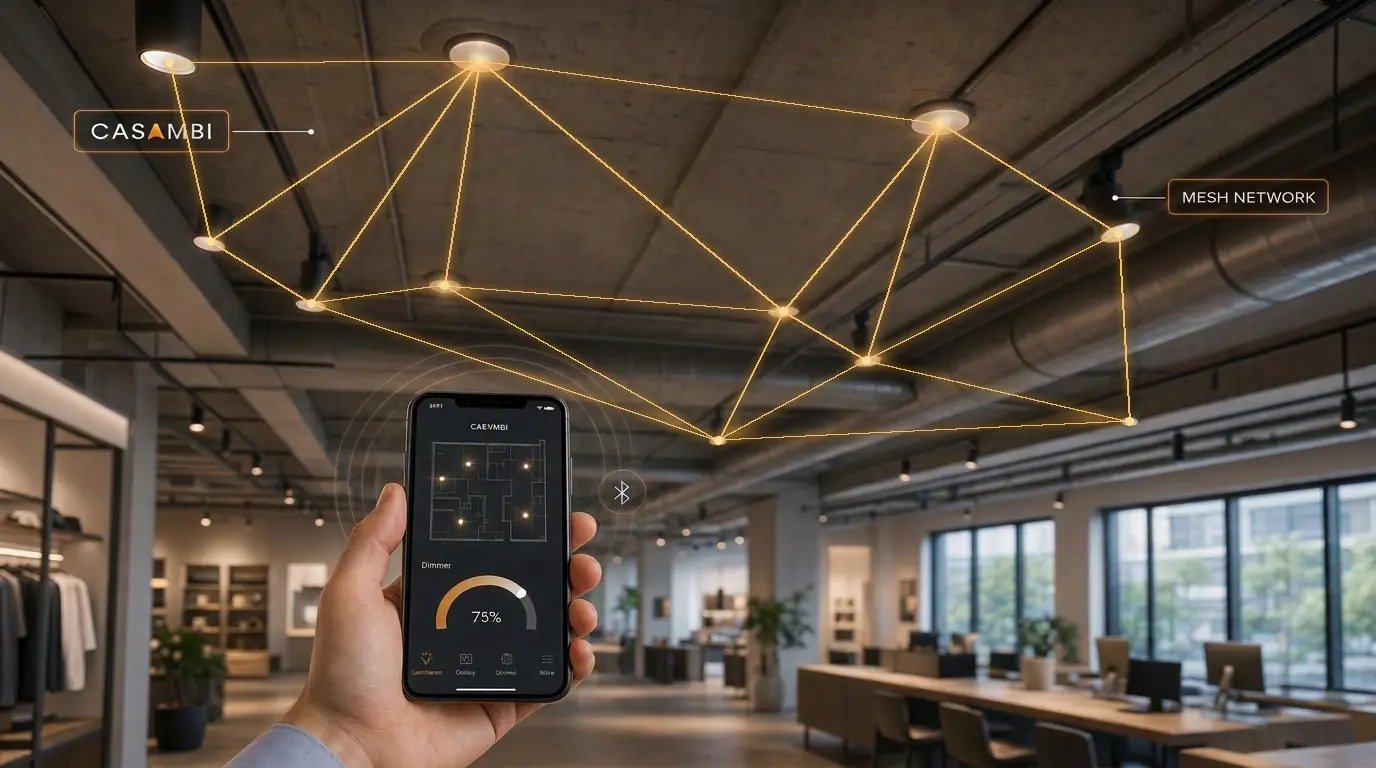
Casambi is a wireless lighting control system based on Bluetooth Low Energy (BLE) mesh technology. Rather than requiring dedicated control wiring, Casambi embeds intelligence directly into luminaires through a small module integrated with the driver.
Each Casambi-enabled luminaire becomes a node in a mesh network. Nodes communicate with each other, relaying signals across the space without needing a central hub or gateway. This architecture scales naturally, adding more luminaires extends the network rather than creating complexity.
Control happens through a smartphone or tablet app. You can create scenes, adjust dimming levels, set schedules, and configure occupancy sensors directly from the interface. For project teams, this means commissioning can happen without specialist software or USB programming tools.
When Does DALI Make Sense for Commercial Projects?
DALI fits projects where wired infrastructure is already planned or exists. New-build CAT A fit-outs often specify DALI because the control wiring can be installed alongside mains distribution during first fix.
Buildings with multiple stakeholders benefit from DALI's stability. The protocol has a twenty-year track record, and DALI-2 certification removes the integration uncertainty that can complicate handover. Facilities managers working with building management systems (BMS) typically find that DALI integrates through gateways to KNX, BACnet, or Modbus without disrupting the lighting layer.
Data centres, where reliability is non-negotiable, often specify DALI because wired communication isn't affected by radio frequency congestion. The same applies to environments with strict electromagnetic compatibility requirements.
When Does Casambi Suit the Lighting Scheme Better?
Casambi excels in retrofit and refurbishment projects where adding dedicated control wiring would be disruptive or expensive. Listed buildings, for example, often can't accommodate new containment routes without affecting historic fabric.
Spaces that change layout frequently, coworking offices, activity-based workplaces, retail stores with seasonal reconfigurations benefit from Casambi's software-based zoning. Reassigning which luminaires belong to which group happens in the app, not through rewiring.
299 Lighting integrates Casambi into almost all our linear, suspended, downlight, and bespoke luminaires. This gives project teams a consistent control platform across different product types without specifying multiple systems. We also offer DALI conversions via Salvador Series controllers for sites that want the benefits of both technologies.
How Do Hybrid Systems Combine DALI and Casambi?
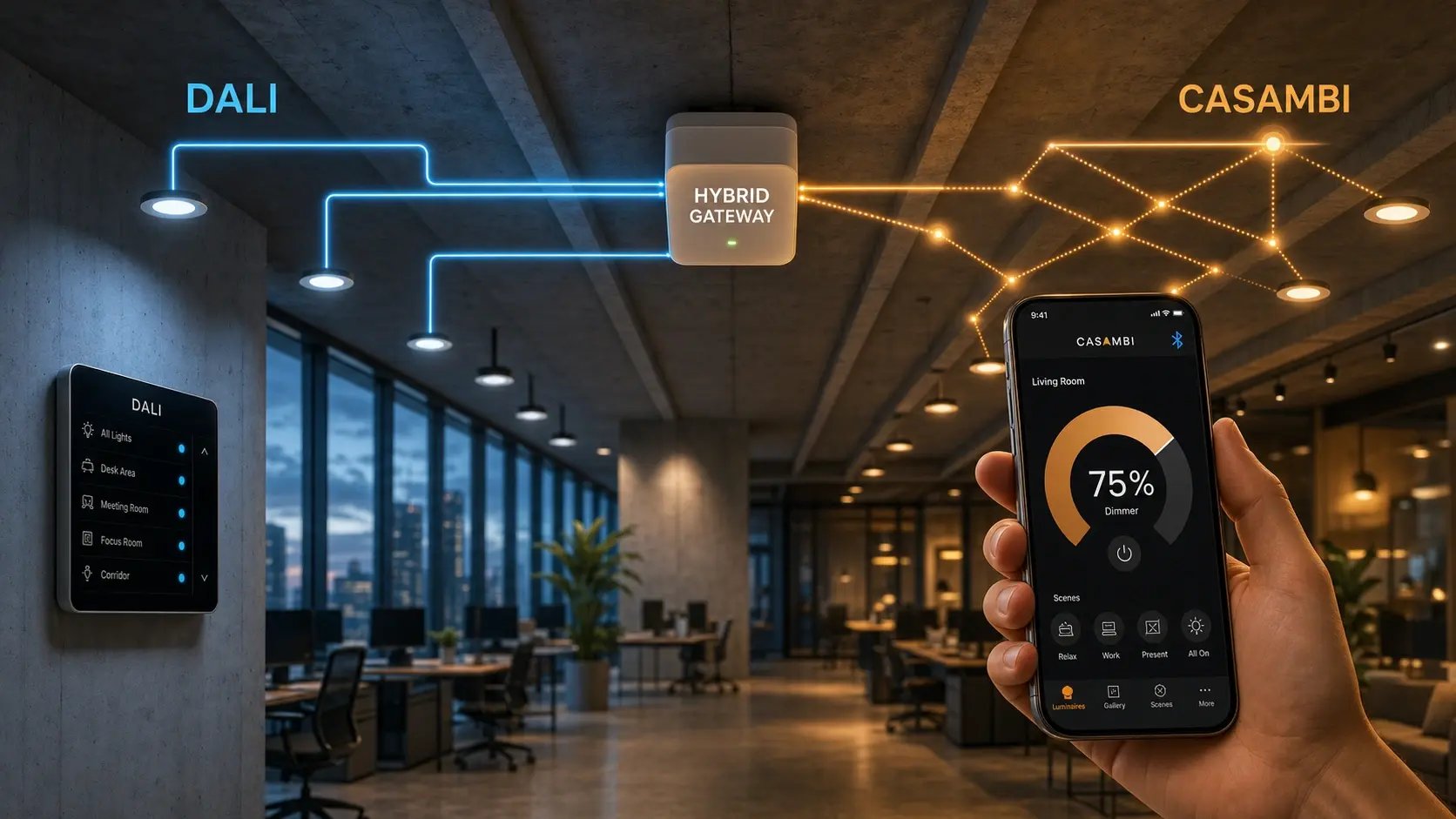
The Salvador Series controllers from Casambi bridge wired DALI infrastructure with wireless BLE mesh. This hybrid approach lets you keep existing DALI luminaires while adding Casambi-enabled fittings or extend a DALI installation into areas where control wiring isn't practical.
A common scenario involves a multi-floor office refurbishment. The landlord's base-build includes DALI-addressed luminaires in circulation areas. Tenant fit-out adds Casambi-enabled task lighting at workstations and meeting rooms. The Salvador controller unifies everything into a single network controlled through one app.
Hybrid systems also future-proof installations. If the building's use changes, wireless extensions can accommodate new requirements without commissioning engineers returning to site for rewiring.
What Features Matter for Occupancy Sensing and Daylight Harvesting?
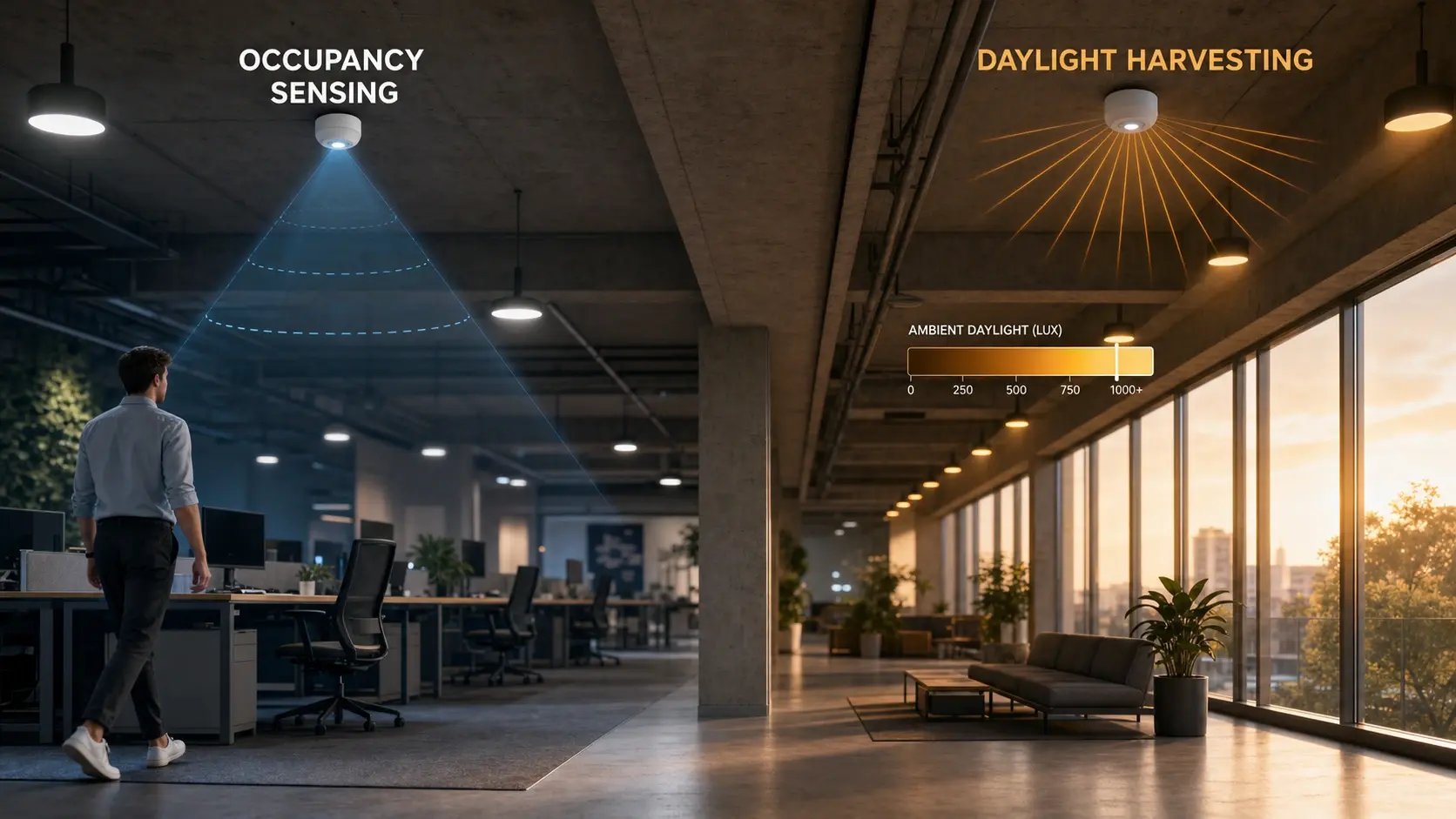
Both DALI-2 and Casambi support presence detection and daylight harvesting, the two automation strategies that deliver measurable energy savings. Occupancy sensors switch luminaires off or dim them when spaces are vacant. Daylight sensors adjust electric lighting to maintain consistent illumination as natural light levels change throughout the day.
According to a UCLouvain study, lighting control with occupancy detection can save 44% on energy consumption compared to manual switching. The key is sensor placement and sensitivity calibrations - something our team supports during design and commissioning.
Circadian lighting adds another layer. Adjusting colour temperature throughout the working day - cooler in the morning, warmer in the afternoon - aligns electric light with natural rhythms. Both DALI and Casambi support tunable white control for luminaires with dual-channel drivers.
How Do You Specify Lighting Controls for Compliance?
UK commercial lighting schemes need to meet LG7 for offices, Part L for energy efficiency, and BS 5266 for emergency lighting. Both DALI and Casambi accommodate these requirements, but the approach differs.
DALI handles emergency lighting testing through standardised commands. DALI-2 emergency drivers can report battery condition and test results back to a central monitoring point, simplifying the log-keeping that BS 5266 requires. At 299 Lighting, we supply integrated emergency options across our product range with full photometric data and spacing calculations.
Casambi integrates emergency functionality through compatible drivers and sensors. The app provides test scheduling and status reporting, though some sites with strict compliance regimes prefer the audit trail that dedicated DALI emergency systems offer.
In Summary: Choosing Between DALI and Casambi for Your Scheme
DALI and Casambi aren't competing technologies; they address different project conditions. DALI delivers wired reliability and standardised interoperability for new builds and BMS-integrated sites. Casambi offers installation flexibility and software-based reconfiguration for retrofits and dynamic spaces.
Working alongside architects, consultants, and contractors, we can take you through all your options to suit your timeline and budget. Whether you need DALI drivers, Casambi-ready luminaires, hybrid controllers, or integrated emergency solutions, 299 Lighting delivers the technical support to get the scheme right first time.
FAQs About How DALI and Casambi Work in Commercial Lighting
Can DALI and Casambi work together in the same installation?
Yes. Casambi's Salvador Series controllers bridge DALI wired luminaires with Bluetooth mesh devices. This creates a unified network controlled through the Casambi app, combining existing DALI infrastructure with wireless extensions for retrofit flexibility.
How many luminaires can a single Casambi network support?
A single Casambi network supports up to 250 devices in basic mode. Larger installations use multiple networks or the Casambi Pro platform for enterprise-scale deployments.
What happens if a DALI driver fails in a lighting scheme?
DALI's two-way communication reports the failure back to the controller, identifying the specific address. This means maintenance teams know exactly which luminaire needs attention rather than walking the floor to locate the fault.
Does Casambi require internet connectivity to function?
No. Casambi operates as a local Bluetooth mesh network. Internet connectivity is optional and only needed for remote access or cloud-based features. On-site control through the app works without any internet connection.
How does 299 Lighting support DALI and Casambi specification?
299 Lighting integrates Casambi into linear, suspended, downlight, and bespoke luminaires. We supply DALI-compatible drivers across our range, offer Salvador Series controllers for hybrid installations, and provide LG7 calculations, photometric data.
Which system is better for a refurbishment project?
Casambi typically suits refurbishments better because it eliminates the need for dedicated control wiring. You can upgrade luminaires individually without disrupting ceiling voids or containment routes - particularly valuable in listed buildings or occupied spaces.