Linear Lighting vs Downlights: Which is Better for Commercial Spaces?
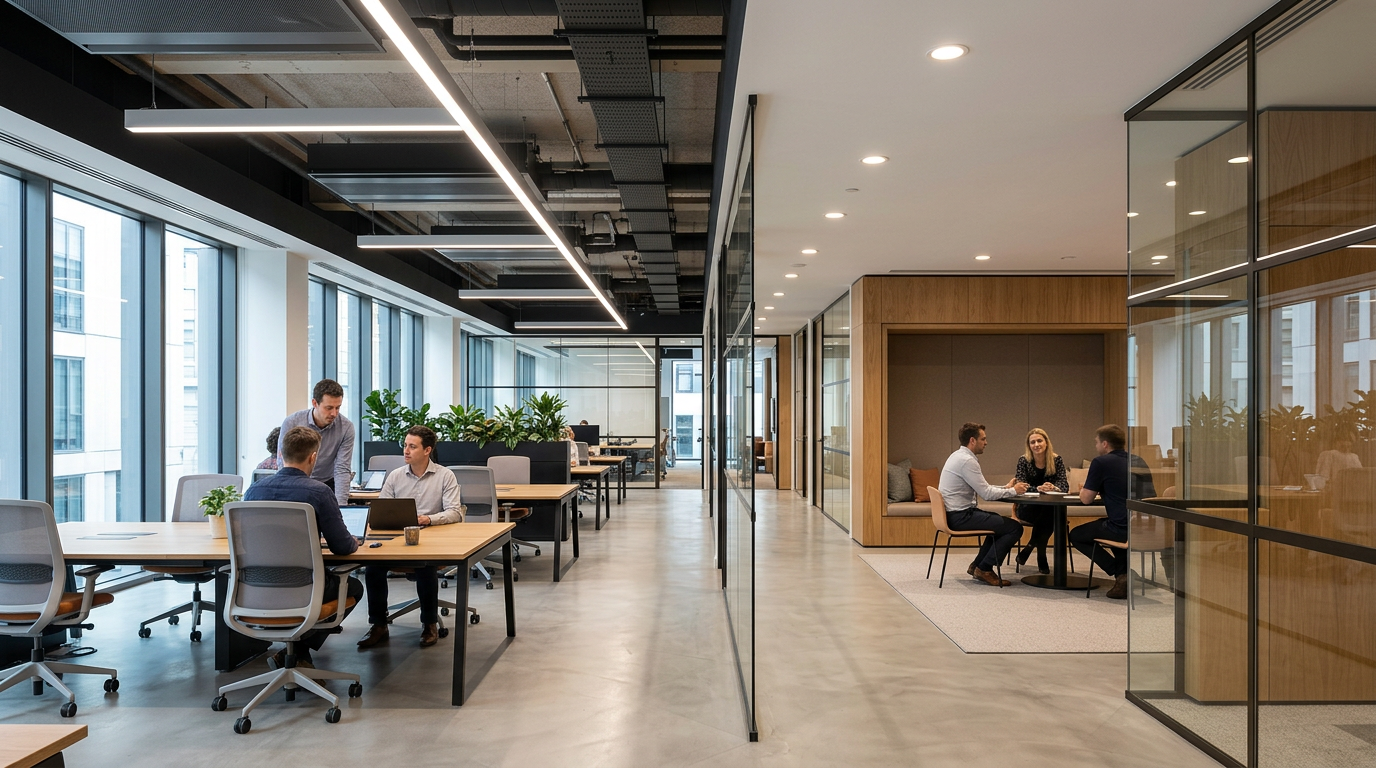
Selecting the right lighting is one of the most important decisions in designing a productive and visually appealing commercial space. Whether you're planning an office refurb, or designing lighting for a new fit-out, or retail environment, the debate between linear lighting vs downlights is central to achieving the right balance of performance, efficiency, and design.
In this guide, we’ll break down the differences between these two popular office lighting types, compare their performance, and help you decide which is best for your specific needs.
What is Linear Lighting?
Linear lighting refers to long, continuous light fixtures that provide uniform illumination across a space. Up until recently, linear lighting was ‘only’ straight lines. Due to the advancements in technology, linear lighting can also be curved, creating continuous waves. It can also be X shaped or have various junctions or connections to create complete unique shapes. Linear profiles can be supplied in standard sizes typically from 600 mm to 2m long or made to measured sizes to create continuous linear lighting systems.
Key Features:
-
Continuous line of light, even light distribution.
-
Linear lighting comes in several mounting types- suspended, recessed trimmless, recessed trimmed, or surface-mounted.
-
Modern commercial ceiling lighting schemes utilise linear lighting for its flexibility and ability to be customised.
-
It is ideal for plasterboard ceilings, SAS metal ceilings, concrete ceilings and exposed ceilings.
-
It is commonly used in open-plan offices, corridors, atrium areas etc.
Linear lighting for offices is especially popular due to its ability to provide direct and indirect illumination (work surface and ceiling) and create a clean, contemporary look.
What are Downlights?
Downlights are recessed ceiling fixtures that emit light in a downward direction, typically in a focused beam. LED downlights come in all sorts of shapes, sizes, finishes and budgets. Some downlights are designed to be practical and are aimed at the back of the house and utility areas, while others are designed to be used in premium front of the house areas or premium retail or hospitality.
Key Features:
-
Compact and discreet. Downlights now come in sizes as small as 35 mm diameter, the more popular downlight size in commercial fit out are around 100
-
mm diameter.
-
Directional lighting (spot or flood beams).
-
Downlights are installed flush into ceilings, either with a trim or without. Plaster in downlights are designed to disappear into the ceilings and create a seamless integration.
-
This type of lighting is most used residential environments, retail, hospitality, and back of the house areas in commercial spaces.
Downlights for commercial spaces are often used for accent lighting or to highlight specific areas.
Key Differences: Linear Lighting vs Downlights
| Feature | Linear Lighting | Downlights |
| Light Distribution | Wide and uniform | Focused and directional |
| Design Style | Modern, architectural | Minimal and subtle |
| Coverage | Large areas | Localised zones |
| Installation | Continuous systems | Individual fixtures |
Which is Better for Office Lighting?
When evaluating office lighting types, the choice depends on the type of ceilings and how the space is used. That gives an indication of a budget for each area. Front of the areas have larger budgets on lighting than back-room areas like cycle storage, corridors or toilet areas.
-
Linear lighting is better for general illumination in open-plan environments where consistency is key.
-
Downlights work well in breakout areas, utility areas or where layered lighting is needed.
In many cases, the best solution is a combination of both, creating a balanced lighting scheme.
Lighting Performance Comparison
Linear Lighting:
-
Provides uniform illumination across large areas
-
Reduces harsh shadows and glare
-
Enhances visual comfort for screen-based work
Downlights:
-
Offers targeted illumination
-
Can create contrast and depth
-
May cause uneven lighting if overused
For productivity-focused environments, linear lighting often performs better as the primary light source.
Design & Aesthetic Impact
Lighting plays a major role in how a commercial space looks and feels.
Linear Lighting:
Linear lighting gives instantly a feel of a more premium fit out or project. It creates clean lines and architectural interest. It is ideal for modern and minimalist interiors. It comes in range of mounting options and optics, giving the designer a freedom to create a completely unique interior design. It can define pathways and zones and it’s also a great vehicle for customisation. Linear lighting can be supplied in all sorts of RAL colours and finishes. Lead times can wary from 2 weeks for standard size lighting to 8 weeks for more bespoke lighting.
Downlights:
Ideal for spaces with lower ceiling voids or ceiling height, as they keep ceilings uncluttered. They might be more easily available, so they are more suited for fast turnaround project with lower budgets.
If design is a priority, linear lighting or systems provide more visual impact, while downlights remain understated.
Energy Efficiency & Sustainability
Energy performance is a key consideration in commercial ceiling lighting.
Linear Lighting:
-
Modern linear lighting uses LED technology that can be specified with high efficiency or high output modules.
-
Fewer fixtures are needed for large space coverage.
-
Lower maintenance due to longer lifespan.
Downlights:
-
Efficient individually, but more units may be required to light a space.
-
Can increase total energy consumption if poorly planned
Overall, linear lighting systems tend to be more energy-efficient and quicker to install for large commercial areas.
When to Use Linear Lighting
Choose linear lighting for offices when:
-
You have an open-plan workspace
-
You need consistent, glare-controlled lighting
-
You want a modern, architectural aesthetic
-
Energy efficiency is a priority
When to Use Downlights
Choose downlights for commercial spaces when:
-
You need focused beam to highlight a specific area
-
Ceiling space is limited
-
You’re layering lighting with other fixtures
-
You are looking to light utility areas
FAQs
1. Can you combine linear lighting and downlights?
Yes, combining both creates a layered lighting design that balances ambient and task lighting.
2. Which lighting type is more cost-effective?
Linear lighting is often more cost-effective for large spaces due to fewer fixtures and lower energy use over time. It is also often easier to install.
3. Are downlights suitable for open-plan offices?
They can be used, but typically as supplementary lighting rather than the main source. The main use of downlights in office space is in corridors and back of the house areas. Smaller downlights can be used as accent lighting in kitchen or breakout spaces.
4. Does linear lighting reduce glare?
Yes, especially when designed correctly with quality micro prismatic diffusers, making it ideal for office environments.
5. Which is better for modern office design?
Linear lighting is generally preferred for modern, clean, and professional aesthetics.