Office Lighting Design Guide: Best Practices for Productivity & Comfort (UK)
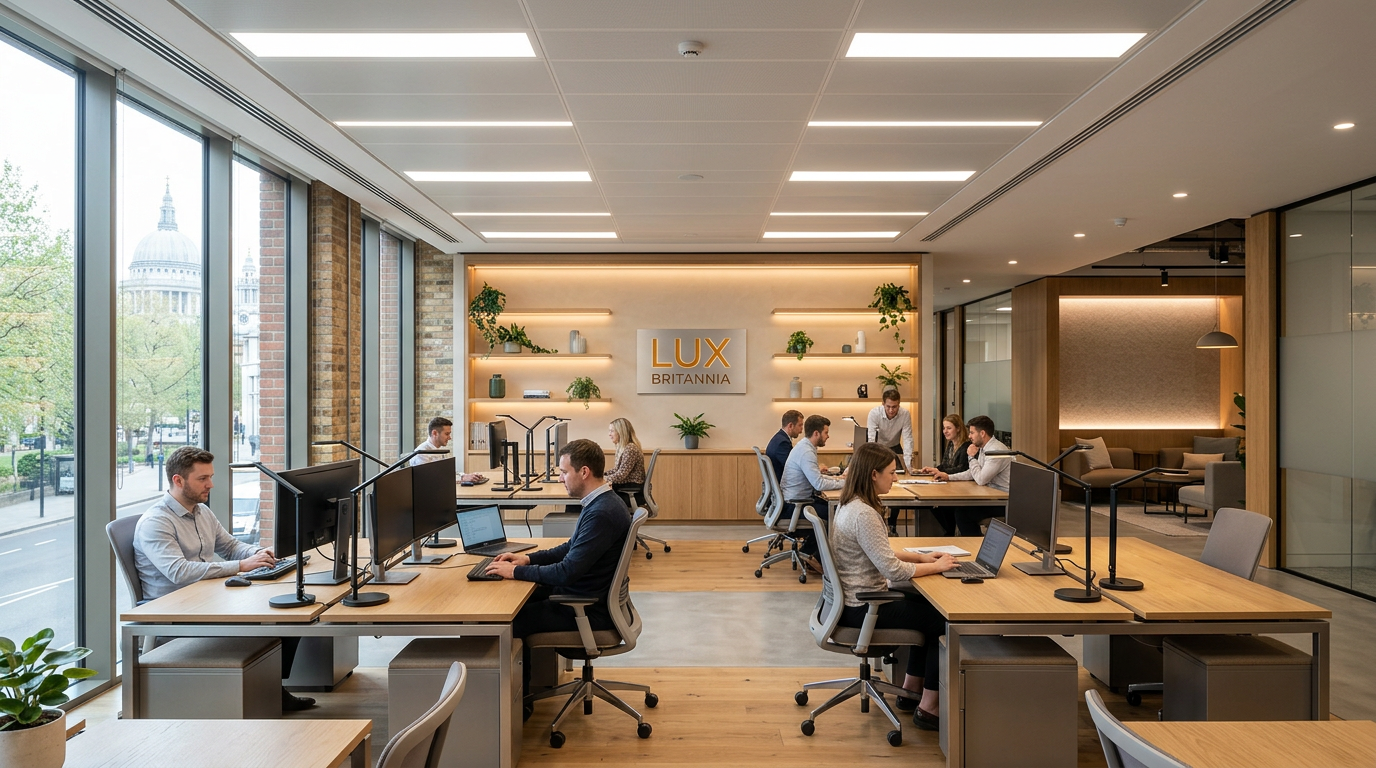
In the post covid world, office space has changed its role significantly. Office is not just a space to work; it is a destination. And as such, lighting in offices had to step up the game. Effective office lighting design is essential for creating a workspace that supports productivity, wellbeing, and efficiency. Poor lighting can lead to eye strain, fatigue, and reduced performance, while well-designed lighting enhances focus, mood, and overall workplace satisfaction.
In this office lighting design guide, we’ll cover everything from lighting types and UK standards to layout strategies all the way to details like colour temperature, helping you choose the best lighting for offices.
Why Office Lighting Design Matters
Good Lighting plays a critical role in how people perform and feel at work.
Key Benefits of Good Office Lighting:
• Improved productivity – Correctly lighting reduces fatigue and increases concentration
• Employee wellbeing – Minimises headaches and eye strain
• Flexibility- Well designed scheme should give the users freedom to adjust lighting to their needs
• Energy efficiency – Modern LED systems reduce operational costs
• Professional appearance – Creates a clean, modern workspace, and enhances the brand of your business.
Businesses investing in office lighting for productivity often see measurable improvements in employee performance, satisfaction and beyond.
Types of Office Lighting
The most important source of light in any commercial space is daylight. It is the most effective form and the most natural way of lighting any space, commercial or residential.
1. Natural Lighting
• Improves mood and productivity
• Should be maximised where possible
In the opening chapters of The BCO guide to Specification 2013, daylight is listed as the primary source of light in office space. The main message of the guide is to use daylight effectively and use artificial lighting only where and when it is needed. This objective also helps us to reduce the amount of energy consumed by lighting.
The artificial lighting in offices is further designed based on the 3 layered approach.
2. Ambient Lighting
Provides general illumination across the workspace.
• Common fixtures: LED panels, recessed downlights, linear lighting
• Goal: Even, consistent lighting
3. Task Lighting
Supports specific activities such as reading or computer work.
• Examples: Desk lamps, adjustable task lights
• Important for reducing eye strain
4. Accent Lighting
Highlighting architectural features or branding
• Examples: track lighting, wall washers, led tape
• Bringing that extra layer of light, making the space look more finished.
Combining these layers creates balanced and flexible office lighting for productivity.
Office Lighting Standards in the UK
Lighting for commercial spaces must comply with lighting regulations and lighting standards. Following the workplace lighting standards is essential when designing an office space.
The key Standard in the UK is the recently updated: BS EN 12464-1: 2021
Among other recommendations, this UK standard outlines recommended lighting levels for indoor workplaces.
Recommended Office Lux Levels:
• General office work: 300–500 lux
• Computer-based work: 500 lux
• Meeting rooms: 300–500 lux
• Reception areas: 200–300 lux
These are generally recognised average lux levels, that should give people a guide of how much light is needed. A detailed lighting design carried out by a professional delves deeper into the areas which are to be lit. The latest lighting standard BS EN12464-1 recognises 3 main areas- task areas, immediate surrounding areas and background areas.
Maintaining correct office lux levels ensures both compliance and employee comfort. It is the role of lighting designers to ensure that correct light levels are achieved by selecting appropriate luminaires that meet the criteria.
Perhaps the next most important factor when designing office lighting is the glare. Light glare is not desirable- It’s an unpleasant sensation produced by bright areas within the visual field. When selecting a luminaire for office lighting, we need to be aware of its UGR rating, as it is an indication of how much discomfort glare it is likely to produce. There are many factors involved when it comes to glare- including room dimensions, room surface reflectance and spacing and height ratio in the determination of UGR. Lighting in office should not exceed the rating of UGR < 19. What this number represents is the glare rating for the entire lighting installation, not for a single light fitting.
Choosing the Right Colour Temperature
Choosing the right colour temperature is key to achieving optimal office lighting for productivity.
Colour temperature significantly affects how a space, commercial, or residential, feels and functions. Colour temperature is measured in Kelvins. As a rule of thumb, most of us would choose 2700K for our homes, as this colour temperature feels warm, cozy and inviting. Commercial spaces would use more cooler colour temperatures.
Recommended Range for Offices:
• 3000K–4000K → Warm-neutral (comfortable, relaxed)
• 4000K–5000K → Cool white (alertness, focus)
Best Practice:
• Use 4000K for most office environments
• Avoid overly cool lighting (>5000K), which can feel harsh
• Consider using Tunable White lighting. The common range for this technology is 2700K- 6500K and it’s beneficial for supporting circadian rhytm.
Lighting Layout & Design Best Practices
When designing commercial spaces, the design of entire ceilings is found in ceiling details. These documents contain information about ceiling types, ceiling height, services like air conditioning, heating and lighting. The detailed lighting layout is known as a reflected ceiling plan (RCP) in professional circles. It states the exact position of luminaires, sensors and emergency lighting. Below are the most common principles when designing a lighting layout.
1. Position Lighting Correctly
• This ensures glare reduction and reflections
2. Even Light Distribution
• Avoid shadows and overly bright spots
3. Take Ceiling Height into Consideration
• Higher ceilings require higher output fixtures
• Adjust spacing accordingly
4. Integrate Lighting Controls
• Motion sensors for energy savings
• Daylight sensors for automatic adjustment
• DALI systems for flexible control
These principles help deliver the best lighting for offices, balancing performance and comfort, however, each space needs to be considered individually by a professional lighting supplier.
Energy Efficiency & Smart Controls
Modern office lighting should prioritise efficiency. Current lighting standards are calling for use of lighting controls and smart systems.
Key Strategies:
• Use LED lighting throughout. Fittings using older technologies can be modernised by retrofitting and brought to modern standards.
• Install occupancy sensors
• Implement daylight harvesting
• Use smart systems (e.g., DALI)
Benefits include:
• Lower energy bills
• Reduced carbon footprint
• Improved system control
FAQs
What is the best lighting for offices?
The most important part is to utilise the daylight. There are several options for achieving well-lit office space depending on your ceiling structure, void, ceiling type etc. Using LED technology is a given. Lighting must be designed to meet current lighting standards to achieve the efficiency, and balance for productivity and comfort.
What are the recommended office lux levels?
The CIBSE recommended lux levels for offices are between 300–500 lux for general work and 500 up to 750 lux for task-focused areas.
Why is glare control important?
Glare can cause eye strain and reduce productivity, especially for screen-based work, video calls and detailed orientated tasks.
What colour temperature is best for productivity?
Cool white lighting (around 4000K) is ideal for maintaining focus and alertness.
How can I improve office lighting efficiency?
A good start is using efficient LED fixtures, as the efficiency of fitting varies by their size, shape, quality of LED chips, drivers and diffusers. Using smart controls, daylight and PIR sensors will reduce wasted light.
Conclusion
A well-executed office lighting design ensures your workspace is productive, comfortable, and energy efficient. By selecting the right lighting types, implementing smart design strategies and following UK lighting guides and standards, you can create an environment that supports both employees and business performance.
If you're planning an office project, investing in professional lighting design expertise will help you achieve the best results—both functionally and visually.