Specifying office lighting in the UK means working to CIBSE Lighting Guide 7 (LG7). This is the primary design guide that sets out how to create a visually comfortable, energy-efficient workspace that meets British Standards. Whether you're designing a CAT A fit-out or advising on a refurbishment, understanding LG7 helps you deliver lighting that works for occupants, clients, and building regulations.
At 299 Lighting, we've supported architects, lighting designers, and electrical engineers through thousands of commercial projects where LG7 compliance is essential. This guide covers what LG7 requires and how you can apply it to your next office scheme.
Key Takeaways: Understanding CIBSE LG7 Lighting Guidelines
- CIBSE LG7 is the UK's primary design guide for office lighting, aligned with BS EN 12464-1:2021.
- Context modifiers allow you to adjust illuminance levels based on task type, occupant needs, and space function.
- Wall and ceiling illumination prevents the "cave effect" and improves visual comfort across the room.
- UGR values below 19 are standard for office environments to control glare on display screens.
- 299 Lighting delivers LG7-compliant lighting designs with full photometric calculations and technical support.
What Is CIBSE LG7 and Why Does It Matter?
CIBSE Lighting Guide 7 (LG7) is published by the Society of Light and Lighting (SLL) and sets out best practice for designing office lighting in the UK. The current version, published in December 2022, aligns with BS EN 12464-1:2021, the European standard for workplace lighting.
LG7 goes beyond simple lux targets. It addresses visual comfort, glare control, daylight integration, and energy efficiency. The guide recognises that office environments have changed significantly with hybrid working, portable devices, and video conferencing.
For architects and lighting designers, LG7 is the reference document that clients and building control officers expect you to follow. Getting it right means creating spaces that support productivity, wellbeing, and compliance.
How Does LG7 Approach Illuminance Levels?
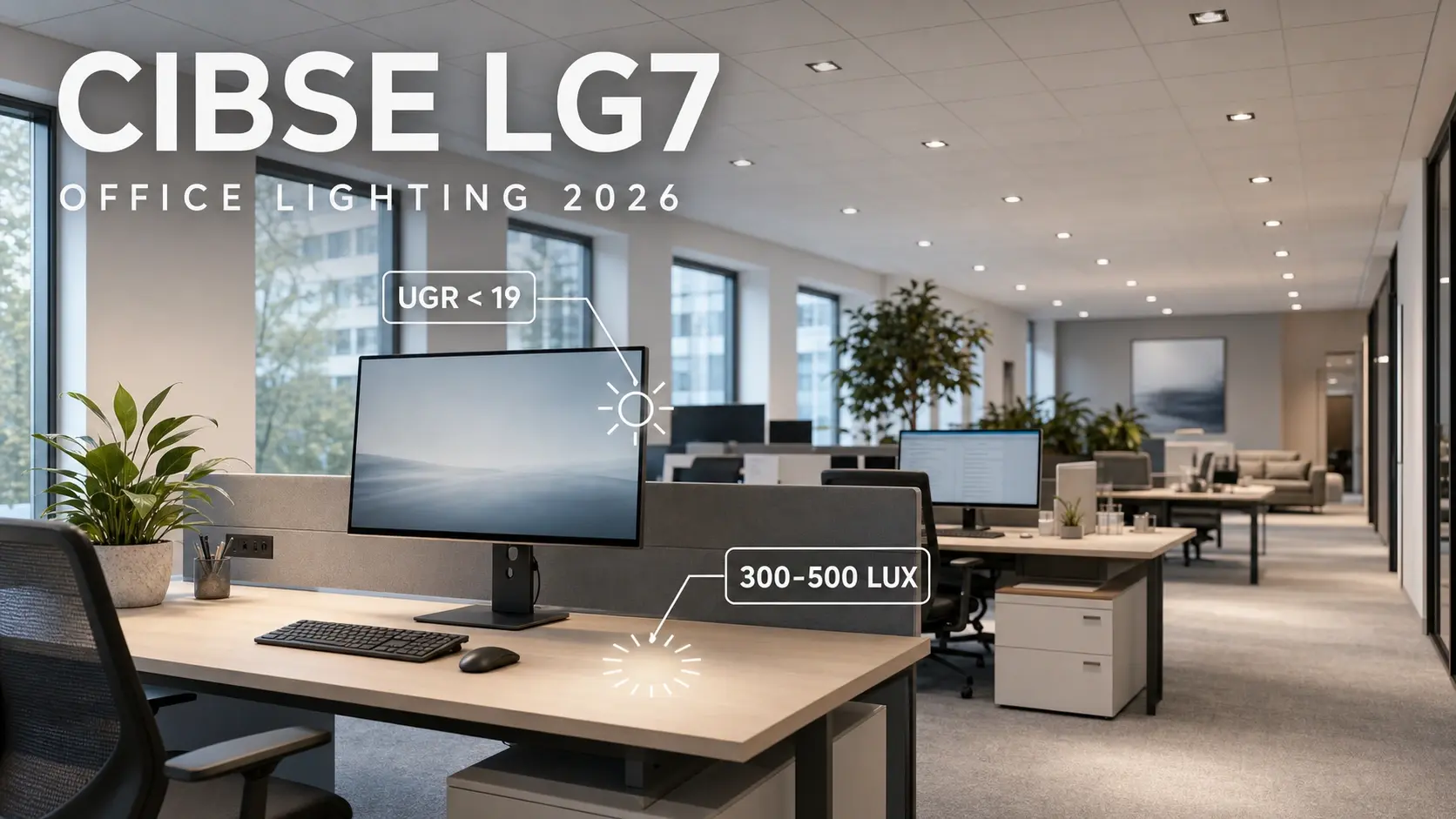
LG7 uses a scale of illuminance values aligned with BS EN 12464-1:2021. The typical starting points for office task areas are 300 lux for screen-based work and 500 lux for paper-based tasks. However, these are baseline figures.
The 2022 revision introduced context modifiers that allow designers to increase or decrease illuminance based on specific factors. These include:
- Visual criticality of the task being performed
- Whether errors would be costly to rectify
- Occupant age and visual capacity
- Duration of task performance
- Daylight availability in the space
This approach means you're not simply applying a blanket lux level across an office. You're tailoring the lighting to how each space will actually be used. Working alongside your project team, 299 Lighting can help you determine the right illuminance levels for each zone.
What Is the 30/50 Rule for Wall and Ceiling Illumination?
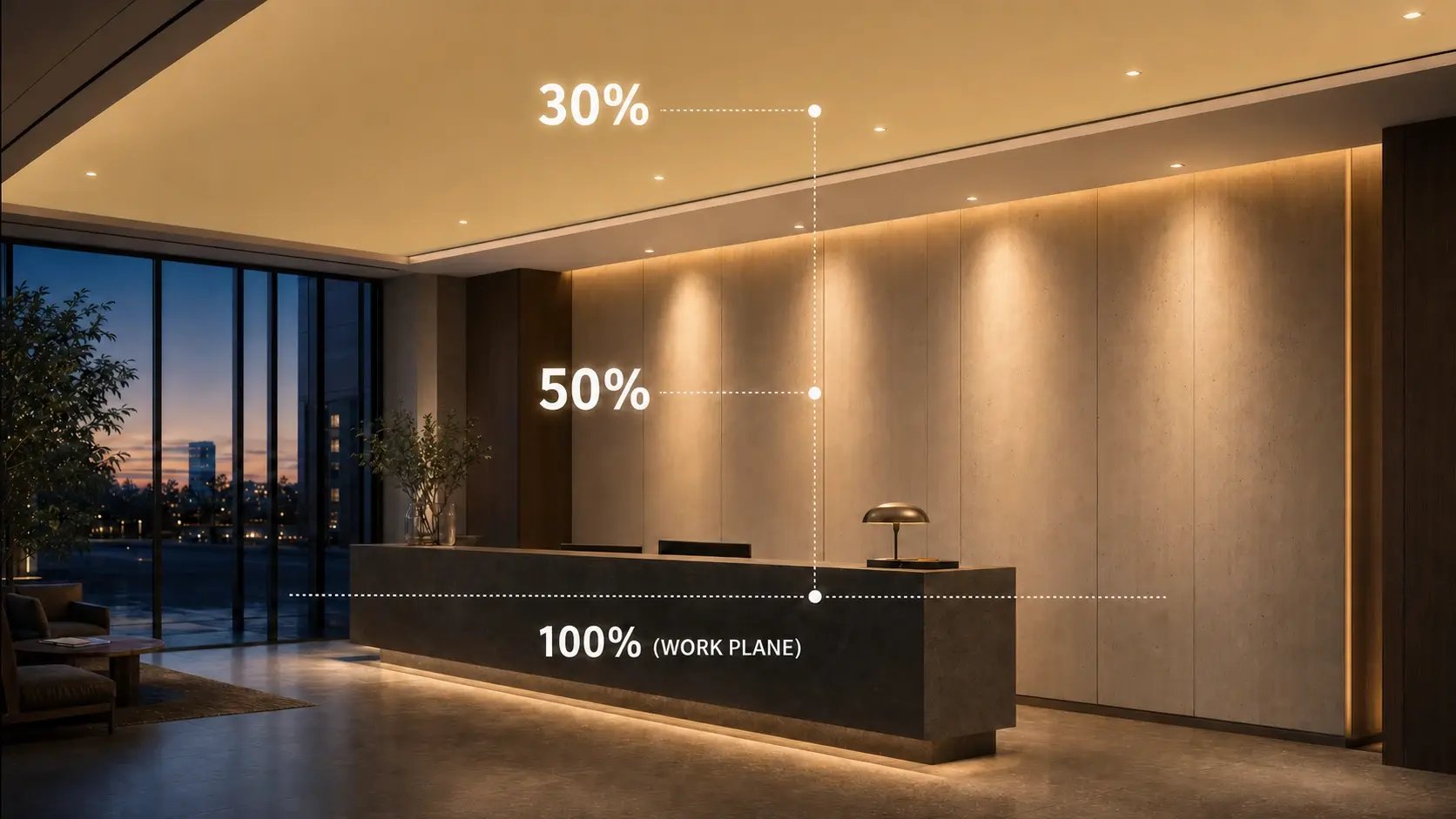
One of LG7's most important requirements addresses wall and ceiling brightness. Historically, office lighting focused on the desk surface while leaving walls and ceilings dark. This creates the "cave effect" a gloomy, fatiguing environment that reduces visual comfort.
LG7 specifies that wall illuminance should be at least 50% of the task area illuminance, and ceiling illuminance should be at least 30%. For an office designed to 500 lux on the working plane, this means minimum values of 250 lux on walls and 150 lux on ceilings.
Achieving these ratios often requires a mix of direct and indirect lighting. Linear luminaires with direct/indirect distribution, or combinations of downlights with wall washers, can help you meet these targets while maintaining design intent.
How Does LG7 Address Glare Control?
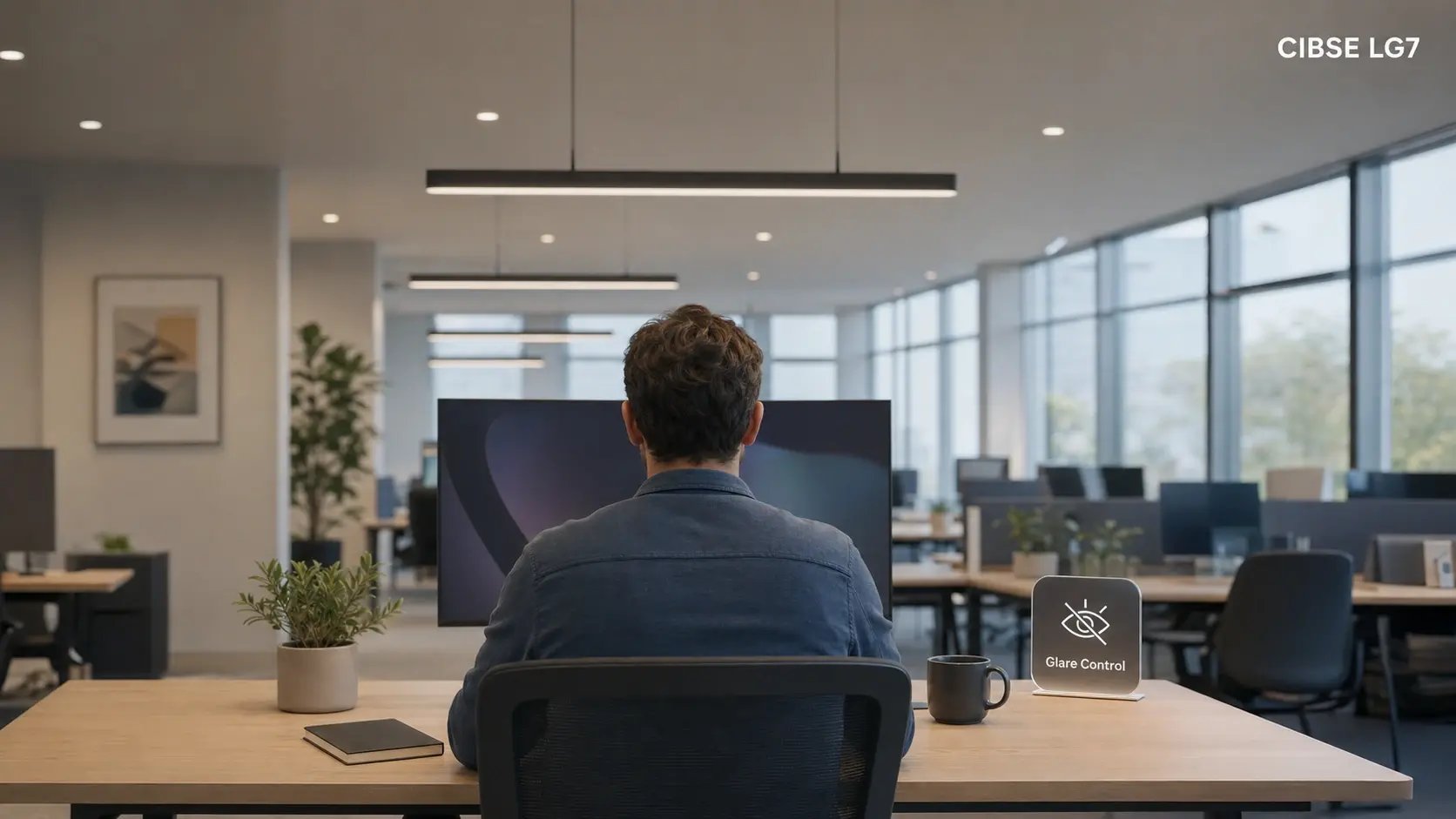
With display screens now standard in every office, glare control is critical. LG7 specifies that luminaires should achieve a Unified Glare Rating (UGR) of less than 19 for general office areas. This limits discomfort glare and prevents reflections on screens that cause eye strain.
UGR values are affected by luminaire type, optic design, mounting height, and room reflectances. Microprismatic diffusers and carefully designed LED optics help achieve UGR19 compliance while maintaining good light distribution.
At 299 Lighting, all our office luminaires come with full photometric data including UGR tables. We can run glare calculations as part of your lighting design to confirm compliance before installation. You can explore our LG7-compliant linear lighting range for options designed specifically for open-plan offices.
What Does LG7 Say About Cylindrical Illuminance?
The rise of video conferencing has changed how we think about office lighting. LG7 now emphasises cylindrical illuminance - the illumination of vertical surfaces at face height. BS EN 12464-1:2021 recommends considering vertical illuminance at 1.2m for seated occupants and 1.6m for standing.
When someone is on a video call, their face becomes their workspace. Poorly lit faces appear shadowy on camera, which affects professional communication. A good lighting scheme includes enough vertical illumination to ensure faces are well lit without harsh shadows.
The modelling ratio, the balance between diffuse and direct lighting, should typically fall between 0.3 and 0.6. This creates enough contrast to define facial features without looking flat or overly dramatic.
How Do Lighting Controls Fit into LG7 Compliance?
LG7 dedicates an entire chapter to lighting controls and their role in energy management and occupant comfort. The guide advocates for intelligent control strategies including daylight dimming, occupancy sensing, and scene setting.
Key control strategies recommended by LG7 include:
- Daylight-linked dimming to reduce artificial light when natural light is sufficient
- Absence detection to switch off or dim lights in unoccupied zones
- Task tuning to set appropriate light levels for different activities
- Manual override to give occupants control over their immediate environment
Wireless control systems like DALI and Casambi make implementing these strategies straightforward, even in fit-out projects where rewiring is impractical. 299 Lighting integrates smart controls into most of our luminaire ranges, with full commissioning support.
What Are LG7's Energy and Carbon Requirements?
The 2022 revision places significant emphasis on both operational and embodied energy. LG7 asks designers to consider the environmental impact of their luminaire choices throughout the product lifecycle.
For operational energy, the guidance encourages maximising daylight, using efficient LED sources, and implementing controls that reduce consumption when light isn't needed. Minimising the installed load while maintaining good light quality is the core principle.
For embodied energy, LG7 introduces considerations that weren't present in earlier editions. It references CIBSE TM66, which promotes circular economy principles in lighting. Where possible, the guide encourages reusing existing luminaires or retrofitting new LED modules into existing housings.
Environmental Product Declarations (EPDs) can help you compare the embodied carbon of different luminaire options. This information is becoming increasingly important for projects targeting BREEAM or WELL certification.
How Does LG7 Apply to Different Office Types?
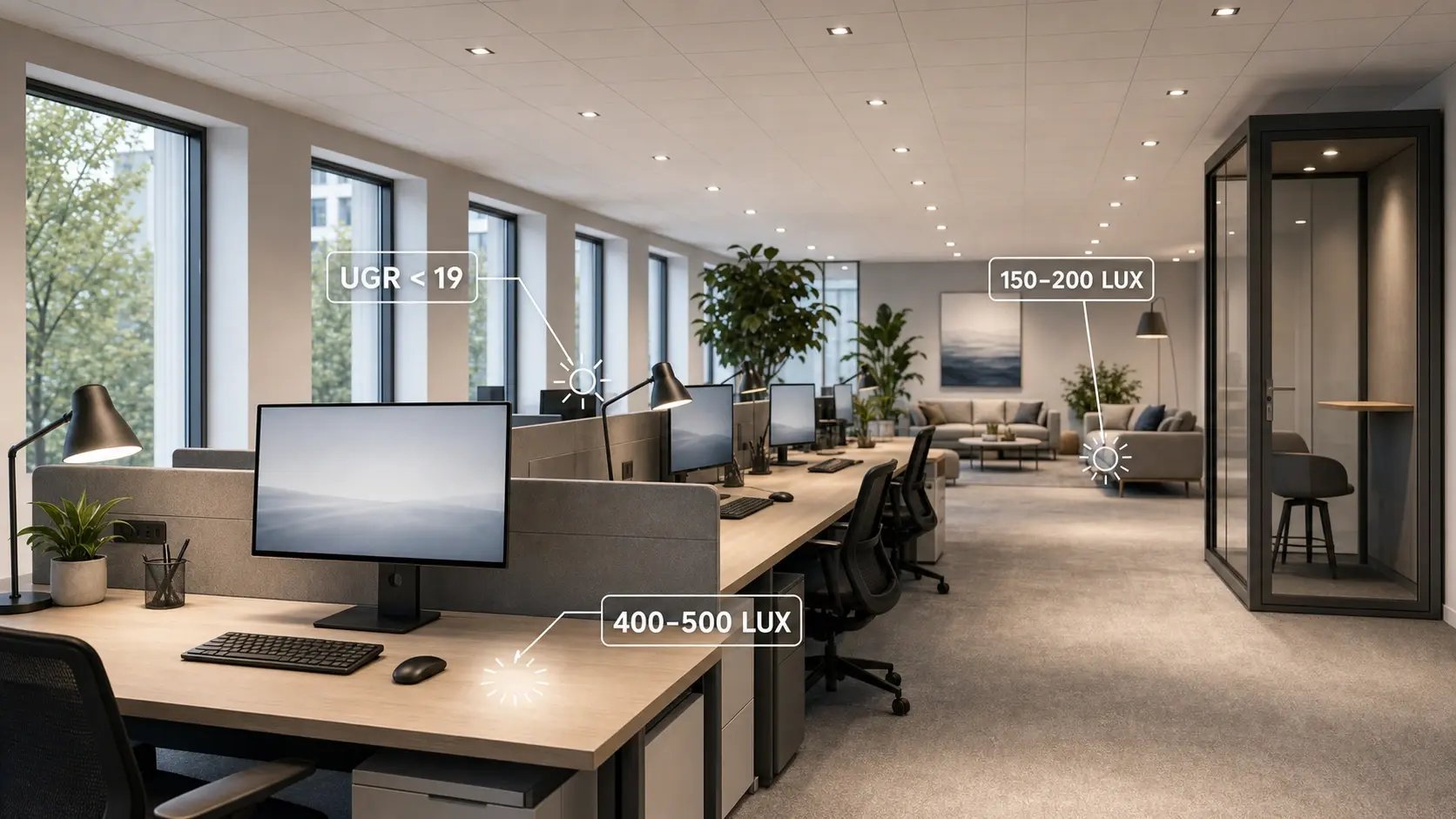
LG7 recognises that offices come in many forms. The guide includes specific sections covering:
- Self-contained office buildings
- Mixed-use developments with office components
- Smaller offices and shared workspaces
- Co-working and hot-desking environments
- Home offices (new in the 2022 edition)
Each office type presents different challenges. Speculative developments require flexible lighting that can adapt to unknown tenants. Hot-desking environments need consistent light levels across the floorplate since occupants move daily. Home offices, often converted bedrooms, require practical advice on positioning desks and supplementing existing lighting.
Chapter 13 of LG7 includes worked examples showing how to apply the guide's principles to specific scenarios, from large open-plan spaces to cellular offices with glazed partitions.
What Emergency Lighting Requirements Does LG7 Cover?
Emergency lighting is integral to any office scheme, and LG7 addresses it in the context of overall design. The guide references BS 5266 for emergency lighting standards while considering how emergency luminaires integrate with the general lighting scheme.
Key considerations include escape route illumination, open area lighting, and high-risk task area lighting. The guide also covers standby lighting, the level of illumination needed to continue essential activities during a power failure.
At 299 Lighting, we've delivered emergency lighting for over 2,000 commercial projects. Our emergency lighting range includes self-test modules, DALI reporting systems, and conversion kits that integrate with general luminaires to maintain design continuity.
Conclusion: Applying LG7 to Your Next Fit-Out Project
CIBSE LG7 represents the current standard of good practice for UK office lighting design. Its emphasis on visual comfort, occupant wellbeing, and energy efficiency reflects how offices are actually used today. The context modifier approach gives designers flexibility to tailor schemes to specific requirements rather than applying one-size-fits-all solutions.
Whether you're working on a CAT A shell and core, a fully fitted-out headquarters, or a refurbishment of an existing building, LG7 gives you the framework to create lighting that meets compliance requirements while supporting the people who will work there.
Want to discuss how LG7 applies to your project? 299 Lighting offers expert consultations to help you specify compliant, high-performance office lighting. We can take you through all your options to suit your timeline and budget.
FAQs About CIBSE LG7 Lighting Guidelines
What is the difference between CIBSE LG7 and BS EN 12464-1?
BS EN 12464-1 is the formal European standard specifying minimum illuminance levels and glare limits for workplaces. LG7 is the practical design guide explaining how to achieve those standards in UK office environments.
Think of BS EN 12464-1 as the "what" and LG7 as the "how." 299 Lighting designs schemes that meet both, with full photometric calculations to demonstrate compliance.
What UGR rating is required for office lighting?
LG7 specifies a maximum UGR of 19 for general office areas where display screens are used. Lower UGR values may be needed in spaces with particularly challenging visual tasks.
299 Lighting supplies luminaires with UGR19-rated optics and can confirm compliance through calculations during the design phase.
How do context modifiers work in LG7?
Context modifiers allow designers to adjust base illuminance levels based on specific conditions. Factors like visual criticality, occupant age, task duration, and daylight availability can justify increasing or decreasing the standard lux values.
This approach means lighting is tailored to actual use rather than blanket standards applied regardless of circumstances.
Does LG7 cover home office lighting?
Yes. The 2022 edition includes a new section on home offices, recognising that hybrid working is now standard practice. The guide covers desk positioning, supplementary task lighting, and how room décor affects light distribution.
Chapter 13 includes a worked example showing how to adapt a converted bedroom into a functional workspace.
How does 299 Lighting help with LG7 compliance?
299 Lighting delivers full lighting design services including photometric calculations, UGR analysis, and LG7-compliant specifications. We support architects, consultants, and contractors from early design through to installation.
With over 2,000 commercial projects delivered, we understand how to balance compliance requirements with practical project constraints.